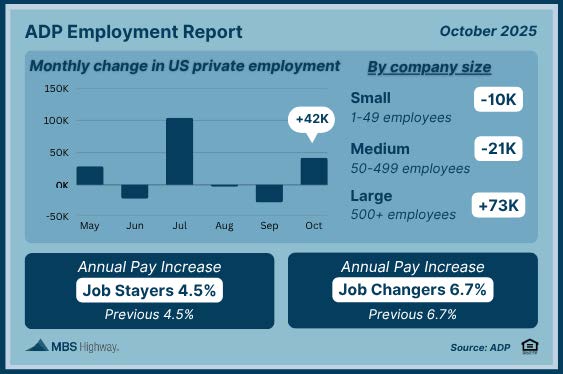
The private sector added 42,000 jobs in October, according to ADP, exceeding expectations of a 24,000 gain. While that marks apositive turn after two months of job losses in August and September, overall growth remains subdued.
By business size, small and medium-sized firms shed 10,000 and 21,000 jobs, respectively, while large companies (500+employees) added 73,000. Sector performance was mixed, with five of ten industries reporting declines. The trade, transportation, and utilities sector stood out, adding 47,000 jobs.
Wage growth continued to favor job switchers, who saw a 6.7% annual increase, compared to 4.5% for those who stayed in their roles. Both figures were unchanged from the previous report. ADP noted that pay growth has been “largely flat for more than a year,” suggesting a balance between labor supply and demand.
What’s the bottom line?
Over the past three months, the private sector has added just 10,000 jobs in total. ADP Chief Economist Dr. Nela Richardson summarized it well: “Private employers added jobs in October for the first time since July, but hiring was modest relative to what we reported earlier this year.”
This month’s ADP report carries added weight as the government’s official employment data for September and October has been delayed by the federal shutdown. That leaves the Fed relying more heavily on private data like ADP’s when evaluating monetary policy.
The Federal Reserve continues to walk a fine line, aiming to bring down inflation while maintaining a stable labor market. Chair Jerome Powell recently cautioned that there’s “no risk-free path” forward and emphasized that another rate cut at the December 10 meeting “is not a foregone conclusion – far from it.”
For now, October’s ADP data likely doesn’t shift the Fed’s stance in either direction: job growth wasn’t strong enough to rule out rate cuts, nor weak enough to make one necessary.
Quick refresher: When the Fed changes interest rates, it adjusts the Federal Funds Rate – the short-term rate banks charge one another. While this doesn’t directly set mortgage rates, it does influence them, along with other key economic factors.